Garth Hudson, 1937-2025
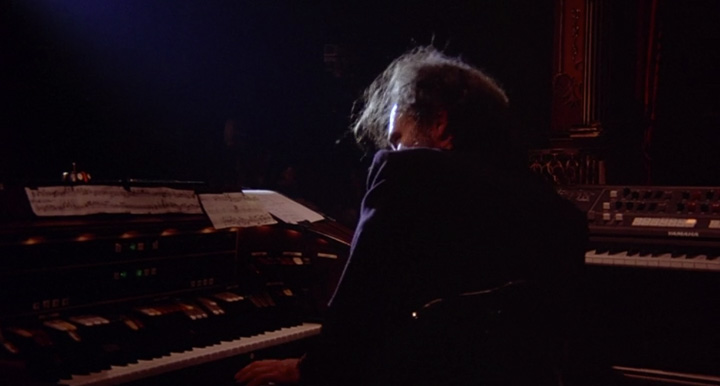
The very first sound anyone hears on the Band’s debut LP Music From Big Pink is that of an organ, melancholically ascending ahead of introducing the other instruments and Richard Manuel’s voice, a kind of knock on the front door from an old friend. It’s sad and haunting, familiar and forlorn, an extension of Bob Dylan’s “wild, thin mercury” sound of Blonde On Blonde.
“Tears of Rage” opens Big Pink, having traversed from a slow folk grind in Dylan’s hands on The Basement Tapes to a steady, driving lament. Behind the organ was the oldest and last remaining member of the Band, Garth Hudson, who passed away in his sleep on Tuesday morning in Woodstock at 87.
Rock organ owes him a significant debt, sure, but to reduce him merely to his keys work, or even just to his work within the context of the Band, would be a disservice to the man whose influence stretches across genres and generations. Lest we forget, this is a guy who could skin a deer with only a penknife, as recounted in Barney Hoskyn’s Small Town Talk.
A native of Windsor, Ontario, and the son of musicians, Hudson was the only classically-trained member of the group, but he yearned to escape the strict confines of that kind of compositional precision. When Ronnie Hawkins and Levon Helm came to him to join their group, he accepted on two conditions: that they would buy him a Lowery organ[1], and that the other members of the group paid him for weekly music lessons. The latter was to appease his parents, who disapproved of his favored rock and R&B. What’s more rock and roll than that? Steve Jones wishes he could’ve charged the rest of the Sex Pistols for wasting his time, if only McLaren hadn’t done it sooner.
You likely know most of the rest from this period: the Hawks ditched Hawkins, joined up with Dylan, toured Europe, made perhaps the best bootleg album ever in The Basement Tapes following Dylan’s motorcycle accident in 1966[2], then became, simply, the Band. That group furthered folk rock ideals and pushed stylistic boundaries within the rock context while retaining the bar-band mentality of a group that spent decades on the road.
As drug addictions and interpersonal fractures grew within the Band, Hudson remained the steady hand, often the principal arranger and chief accompanist on instruments largely outside of the rock paradigm of the late 1960s[3]. Even in eschewing the dominant forms of the day, Hudson could shine a mirror and highlight what pop was missing. His clavinet playing on “Up On Cripple Creek,” for example, complete with wah-wah augmentation, became a prevailing sound of funk in the 1970s[4].
An introverted multi-instrumentalist, he played brass, horns and the accordion as well as keys. Two key examples of his wide-ranging talent are the studio version of “Ophelia,” on which he played all brass and woodwinds, and his saxophone solo during “It Makes No Difference” from The Last Waltz, where he seemingly arrives out of thin air to steal the moment.
His indelible skill memorably runs through “Chest Fever,” which Helm believed should have earned Hudson a songwriting credit along with nominal composer Robbie Robertson (Helm and Robertson publicly fought over writing credits until Helm’s death in 2012, but even as he repeatedly went into bankruptcy, Hudson never seemed to care to engage in such squabbles). Hudson managed to expand the intro to that song live into a fluid, improvisational test he dubbed “The Genetic Method,” which often intertwined Bach leanings with Scott Joplin, Fats Domino and Jelly Roll Morton.
After the original incarnation of the Band came to an end, Hudson spent a lot of time as a session musician and sideman, often playing with those he had influenced. Along with Helm and Rick Danko, he accompanied Roger Waters on a 1990 tour of Pink Floyd’s The Wall. He kept necessarily busy, maintaining a home in upstate New York and guesting wherever and however he could.
With Garth Hudson’s death, the living story of the Band sans Dylan ends. Hudson, though, retains a bit of Tom Joad in his personal legacy: wherever an organ flares to elicit emotional response, he’s there. Whenever a barrelhouse piano run buttresses a folksy dirge, he’s there. When the lyrics end but the music carries on, he’s there.
[1] As opposed to the then-pop standard Hammond organ
[2] Hudson himself operated the recording apparatus for the 1967-’68 sessions
[3] Read: acid-soaked psychedelia, extended guitar solos and lyrics even more fantastically surreal than anything Dylan had done to that point (which isn’t to say they were good)
[4] Just ask Stevie Wonder
 Tuesdays With Horry