It’s Not Working
I. On the Ground
It was like watching someone at a party explain why William Gaddis is great. Under that famously strong Dutch sunshine (said no one ever), Pecco Bagnaia again justified the common wisdom of what’s increasingly felt like a foreordained second MotoGP championship by controlling his second premier class Dutch TT victory from the front. It’s easy to see in hindsight how he drew in Marco Bezzecchi — the only other rider with a serious chance of beating him — just close enough before pouncing on Brad Binder and leaving Binder as a roadblock for Bezzecchi to deal with while he gapped them both; hell, it was easy to see in real time. We already knew the guy liked the place (a tattoo of the circuit layout on his arm in honor of his first win aboard a Moto3 Mahindra back in 2016 gives that away), but this one felt textbook to the point that merely seeing the result suffices.
Ever read J R and then try to talk about it with other people? That thing’s the sort of tedious masochism people will just yes you to death over because they don’t want to read it themselves, but also: They don’t really believe you because how could a book about a middle schooler amassing a business empire built on pennystocks told almost entirely in impenetrable dialogue be better than Lord of the Rings? It’s a boring discussion that would likely have you walking away doubting yourself because just listen to yourself.
– – – – –
That’s been the Pecco Bagnaia Experience™ in MotoGP thus far. As this website once noted, he arrived immediately quick in preseason testing ahead of a much ballyhooed 2019 that eventually netted a fourth in Australia and basically nothing else. Another lackluster year amid an anachronistic 2020, Bagnaia since has settled down and come all the way into his own, winning four of 2021’s final six races to finish second overall and then overcoming a record 91-point deficit to take his first championship in 2022. Apart from some forgettable mistakes in Argentina, the U.S. and France, he’s otherwise been on the podium in every race so far in 2023, and there’s no reason to think more aren’t on the way after the five-week summer break.
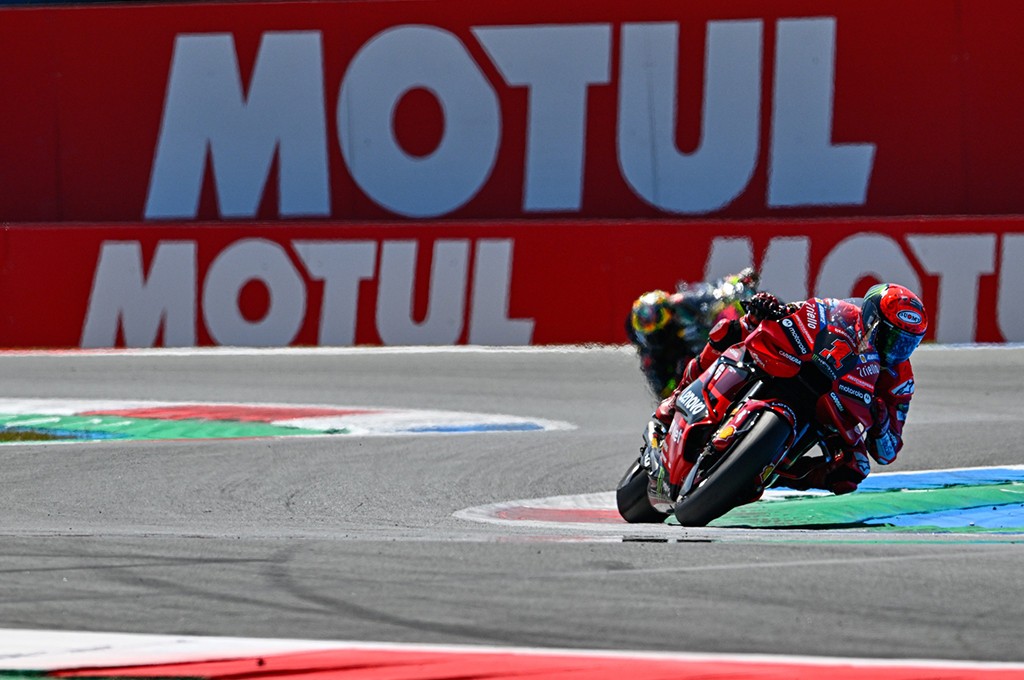
And yet. There is something about Bagnaia that feels deeply unconvincing. The Dutch TT was another ride that made evident why he’s elite, why he wears the #1 plate, explainable enough to someone who’s never seen him before that the man is smooth as silk on a bike devised largely with him in mind — but that’s just it: It’s devised with him in mind. He’s aboard inarguably the best motorcycle on the grid and has been for several years now, receiving factory support and full attention in the wake of Enea Bastiannini’s injuries… and at midseason, he’s 35 points ahead. That’s barely a win. It’ll likely increase after the break, but Pecco’s just as likely to fold on an unforced lowside and let the others catch up again. But he’s great, right? Right?
The Ducati stable is an embarrassment of riches right now, with five of the top six riders in the standings all aboard a GP22 or GP23, and from Bezzecchi and noted New York Rangers fan Jorge Martin on down, any of them (even Fabio Di Giannantonio) could take a victory. Pecco’s modest personality belies a wild side befitting his stature as the world’s current best rider1, but it also suggests his killer instinct isn’t as formidable as, say, Bastiannini’s or Bezzecchi’s. Jorge Martin took it to Bagnaia in Germany the week before the Netherlands and he’s out for the blood red of Bastiannini’s factory seat; Enea needs to get healthy so he can get consistent and get his confidence back. Bezzecchi’s looking to take Zarco’s seat. They are all gunning for each other and giving Pecco the data while they do it. Bagnaia is directly in that line of fire just above them all benefiting from it for now. I’m not sure he’s really ready for what’s coming.
In that way, Pecco reminds me most of Jorge Lorenzo. Lorenzo’s ego eventually got the better of him, but in MotoGP’s Alien Era, it was always Lorenzo who felt like the least believable of the quartet at the front. Maybe it’s because he arrived after Rossi, Stoner and Pedrosa; maybe it’s because he always felt like he was sniping at Valentino like a little kid. Probably it’s because his best rides were singularly boring affairs where he rattled off metronomic, stopwatch-breaking lap times that only beguiled the eye for their consistency. Lorenzo won not because he was spectacular but because he was ruthlessly consistent if he could get out front. I can’t remember a classic race in which Lorenzo was on the winning end. I suspect it’s going to be like that with Bagnaia, too. I barely even remember the race I saw this morning. A lot of this year has been like that.
Brad Binder would probably rather forget what he saw. For the second day in a row, Binder was caught overstepping the white line and triggering a long lap penalty he couldn’t serve because it was the last lap, so instead they docked him three seconds and dropped him one position behind Aleix Espargaro. Two podiums wiped out by the stewards, but as Brad suggested Saturday: What can you do? You move on and try not to make the same mistake twice.

Even so, KTM must be heartened by the fact that they have not only the biggest personalities on the grid — you find me a fan who hates Binder or Jack Miller, I’ll find you someone who isn’t a fan — but also the only bikes giving Ducati any grief at the moment. Aprilia’s year was supposed to be a lot stronger than this, but Espargaro and Maverick Viñales haven’t found the consistency of a good base setup and it’s costing them race in, race out; KTM, meanwhile, seem to have an advantage over the Dukes on braking that they, like everyone else, then lose on corner exit. The aero package is close and the summer break might help, but to get it all working in concert, they’ll have to find just that little bit extra.
Fabio Quartararo will be looking for more than “just that little bit extra.” The 2021 champ has looked positively anonymous most of the year and Assen was Yamaha’s best chance to showcase its inline-four-cylinder’s midcorner speed. In the Saturday sprint, Quartararo got a decent start and was able to hang with the leaders for the duration, ultimately getting the promotion to his first podium of the year after Binder’s (first) penalty despite an injured foot. Sunday, however, brought him back to a familiar midfield position and, ultimately, a front-end slide into retirement. I’m not going to look this up, but I’m certain Franco Morbidelli was somewhere between 10th and 14th2. The team has some work to do to convince Fabio to stay, but where would he go if he decided to leave? And Morbidelli finished second overall in 2020, it’s not like that talent just evaporates. Ducati doesn’t need more riders. KTM, maybe. Aprilia, maybe. But who among their own would they sacrifice?
Only at Honda did the mood remain grimly unchanged. What was once MotoGP’s most formidable team feels like a laughingstock and words are starting to get more forthright, an alarming scene. Joan Mir — a guy you might remember from 2020 as one of only two people to win a world championship on a Suzuki since 1982 — tumbled out of the entire German GP weekend and has finished exactly one race all season. Alex Rins — a guy you might remember as the last person to win on both a Suzuki and a Honda as of this writing — has been out since Mugello, a round before that. Taka Nakagami scored an eighth on Sunday and is tied for 15th in the standings, the highest-ranked Honda rider in the championship through sheer consistency, and he’s probably out in favor of Ai Ogura next year. The world’s most dangerous rider can’t make a package tailored for him work, and while it’s been commonly acknowledged for years that Marquez has never been a great development rider, it’s also what, perhaps counterintuitively, made him great: Give him something obviously uncompetitive in anyone else’s hands and he’d still find a way to give you a victory back.
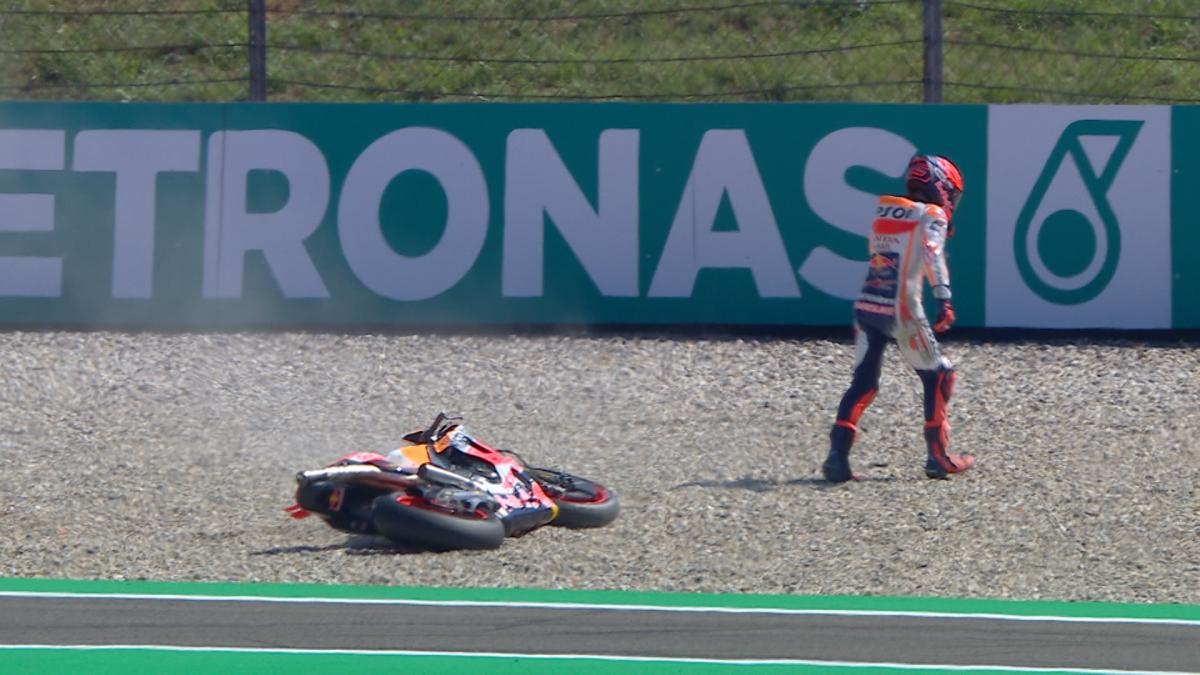
That’s no longer possible. The level of competitiveness is too high, the field too close in performance; even Mir’s sub Iker Lecuona pulled in Sunday bashing the tank of his RC213V. That Honda is a poison for all parties concerned and there are some very intense discussions over what lies ahead for 2024. It was Marquez’s initial prolonged absence that gifted us the sport’s most memorable season and tore asunder the old world of personalities to make way for a new generation, but promoters still rely on his star power because Quartararo and Mir are hampered by their more earthly forms and Bagnaia is practically Alex Criville in interviews. People have very strong feelings about Marc. No one’s jeering Pecco.
Ultimately, this happens with every generation. You have to let Rossi go the same way you let Doohan and Rainey and Schwantz and Lawson go the same way you let Sheene and Roberts go the same way you let Ago and Geoff Duke go. They all go eventually. It just shouldn’t feel this dejected, this flat.
– – – – –
II. From the Tower
Here’s what Binder did to earn that one-place penalty Sunday, by the way, an almost identical error to the one he made Saturday:

Can you see it? Is it clear as the dead of night? Cool. Now take a look at Pedro Acosta running a penalty long loop in the Moto2 race an hour before:
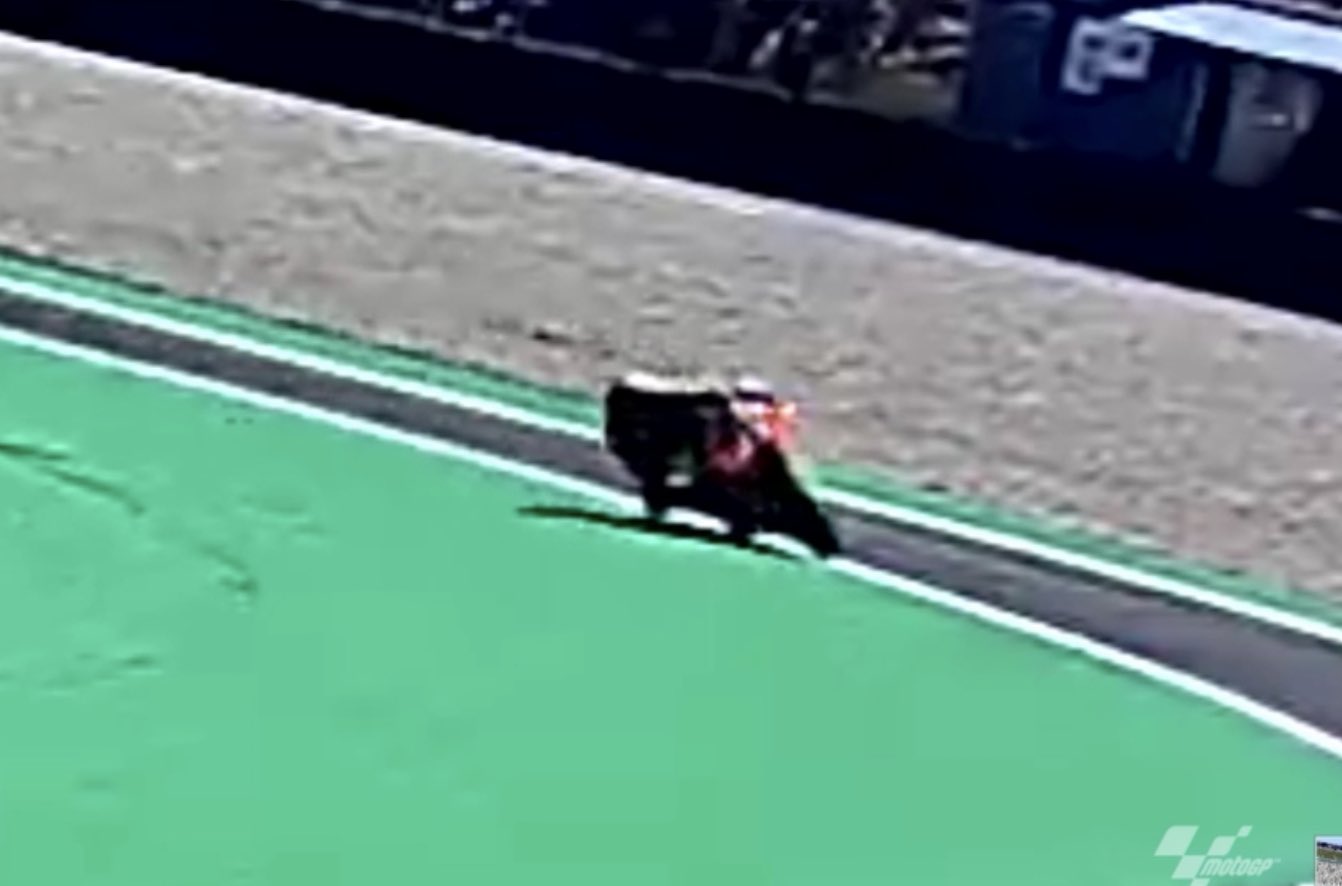
Can you see it? Is it clear as the dead of night? Cool. Guess how much Acosta was penalized for riding the green.
If you answered “nothing, because long lap loops are monitored using only CCTV footage and not sensors, so a subjective decision must be made instead,” take a bow: You belong on the FIM’s stewards’ panel alongside former double 500cc world champ Freddie Spencer (American) and two other guys whose names are very difficult to find without some digging: Ralph Bohnhorst (Czech) and Mario Solana (Portuguese). The much harried stewards’ panel has had a lot to answer for since it was first formed in the wake of the Rossi/Marquez clash at Sepang in 2015, but it’s been especially noticeable in 2023 as riders, teams, the media and fans all remain equally mystified by the inconsistent decisions coming down from the control tower.
“We have over 90 cameras now, counting CCTV, that we can have access to,” Spencer said following a meeting with riders and teams in France that promised a rare chance to hear where they were coming from but delivered only more confusion for most. “We have a race control suite, we can monitor anything from when the crashes happen, all of the times, be more accurate when they do shortcuts, or on-track positioning, go off the track, track limits. If we give someone that they have to lose a certain amount of time, [we can be more accurate].”
That sounds great on paper, but in practice, it’s not translating yet. Far from a conspiratorial board of Spaniard-favoring hucksters, these guys simply appear to be incompetent at their jobs. Even leaving aside that you can’t please everyone all the time if you’re working to the letter of the law, the margins for what the commission leaves for error or aggression varies wildly not just from class to class, but from incident to incident in a single race. Go look for yourself and see how frustrated riders are because they don’t know what they’re allowed to get away with in the heat of battle.
When you have riders scared to make moves, as Bagnaia was on Marquez in France, the quality of racing drops, becomes more processional. It gets worse, in a word. And it couldn’t come at a worse time.
– – – – –
III. Over the Air
How close was I to buying a flight to Portugal for the season-opening round in Portimao? Let’s put it this way: I had a flight tracker for a few weeks in the winter and more than once clicked the Google Flights link through to TAP’s page to complete my purchase. I’ve never been to Portugal and, I mean, look at a map: It’s right there. The seaside, the complex colonial history, the world’s sturdiest cork supply, a language that may as well be Spanish with a bunch of extra tildes. Doesn’t that sound nice? Well, of course it does. What held me back were all the sobering considerations that tether us to the real world: work scheduling, vacation days, family matters. The opportunity to be present for MotoGP’s inaugural Saturday sprint (but not race, an absurd pedantic discrepancy to distinguish it from the Sunday full-length features), like a lot of other things, passed me by. A friend of mine just got back a few weeks ago after a long European jaunt to open festival season. She said it was incredible.

Even knowing that and seeing all the Instagram posts, though, I don’t regret my decision. I would’ve witnessed Marc Marquez wiping out what might ultimately be Miguel Oliveira’s career — his return from a shoulder injury at Jerez after Marc knocked them both off in Portimao was rewarded with a dislocation of the humerus bone on his left arm after Fabio Quartararo unavoidably wiped him out in the first start, then a fracture in the humerus of his left shoulder after further examination once the arm was fixed, and who knows how long that’ll take to fully heal, if ever, though he was back on the bike for Mugello — and a mess of overriding that ultimately ended in, what else, Pecco Bagnaia winning. It wasn’t a convincing argument for the format.
There was a great deal of debate after the initial races that saw some chaotic Saturdays lead to needless injuries that led to emptier Sundays. Riders were throwing everything at Saturday sprints because that’s what they’re paid to do and it is, in every sense but the branding one, a race; that meant a higher risk of injury, which has ticked up noticeably this year. Need proof? Consider this: Not once have we had the full original lineup of riders on a MotoGP grid in 2023. Zero times. Pol Espargaro reappeared in front of his GasGas team in the Netherlands Saturday for the first time since his injury in Portimao and told the media he lost 1.5cm off his spine “but it’s okay, I am already married and have kids”; God knows when that dude will throw a leg over a motorcycle in anger again. Guys are all but killing themselves to bag half points in a pressure cooker that has every chance of removing you from the possibility of a “real” win on Sunday, and for what?

Don’t worry, series promoter Dorna has those stats handy: Thanks to the extra races on Saturdays, trackside attendance with “available data” was up 40% heading out of Le Mans, TV viewing on Saturday had increased 51% and overall weekend viewing was up 27%. The French round even saw record attendance. And for what? A battered grid is going to grow the sport?
But let’s leave aside the litany of injuries for a moment — get well soon Pol, and Joan, and Alex, and Marc, who withdrew from the Sunday Dutch round after finishing 17th on Saturday, not to mention the riders currently injured but still competing that include the likes of Fabio, Enea, Aleix, have I forgotten anyone? I can’t remember, and I guess that wasn’t just a moment — and let’s also leave aside the stewards’ rulings that require a Ouija board to understand. Let’s ask a much simpler question: What the fuck are we doing here?
It’s like I’m looking at a sport I no longer recognize every time I tune in — which is still almost exclusively on Sundays, by the way; I keep forgetting Saturday races happen and then wonder why guys are missing if I haven’t caught up on my Twitter feed. I know I come to this as a longtime fan and so my perspective as an older, traditional devotee is not welcome or desired since it’s assumed I’ll watch regardless of what they do to butcher the format, but also: Will I? Races don’t feel as special anymore not only because there are 20 rounds on the calendar, already the most in the series’ history, but also because there are two races every weekend on consecutive days now. It’s not enough to just be able to tune in on Sunday and see the biggest sporting event of my week; now I have to make sure I catch the half-hour sprint on Saturday. I used to think World Superbikes were pushing it with two rounds apiece, but at least they didn’t go to as many places; then Dorna bought them and gradually started expanding their calendar. Then they made it three races a weekend. I don’t even bother watching anymore, which is too bad when you have a Janus-faced season like 2019 to match years of yore (and here I mean 2002) in every other way. If only I’d done more than read about Jonathan Rea’s epic comeback, I could be excited about it. As is, all the stakes feel lower.
That’s the ironic part of this poorly thought-out ploy Dorna obviously lifted from WSBK (and, more blatantly, Formula 1): I haven’t cared so little about MotoGP race weekends since I started following it really closely as I have this year. It no longer feels fun tuning in to watch a race; it feels like work now trying to keep up with it all. It’s a job watching on Saturdays. Baseball, basketball and soccer fans might scoff, but they’re all operating from the perspective of an innate surplus: I wouldn’t give a fuck about 162 races a year, either, never mind 82 or whatever soccer league your favorite plays, but that’s also how they’ve always done it and it’s also much simpler to put on one of those games. Part of racing’s charm was that there was an exclusivity to it in the manner of the NFL (which: I know, also expanded its season). What we’re talking about is 40 races over 20 weekends — just few enough that you could conceivably keep up with them all, but just enough to also feel laborious if you did. The joy that motorcycle racing has brought to my life in the last 20 years is incalculable and I’d never trade the thrills I’ve gotten from watching some of the best do their best in real time, but MotoGP in 2023 isn’t what I signed up for. Half the grid is injured, there are too many races, there are too many rules, and all of it’s conspired to make a worse product.
Which is what we’re really talking about, isn’t it. We’re talking about consumption, about capitalism. It’s not working, none of it is for me, but it’s not really about me, the fan. We know what it’s about. It’s surprising Dorna didn’t propose the format change sooner in an effort to extract more everything out of everybody involved: more time, more money, more energy. Teams are away from their families for weeks at a time for months out of the year; I don’t know what the divorce rate in the MotoGP paddock is, but it can’t be low. Maybe some don’t even bother, knowing full well what they’ve gotten into. It’s a committed life, but it doesn’t have to be this strained for anyone. We could all agree we don’t agree more racing is better just because it’s more. We could all agree MotoGP doesn’t need to grow (or at least not in the ways F1’s had to grow because its product sucks a lot more than MotoGP’s does, a thing no one in bikes ever seems to acknowledge). Only the myopic mentality of the money men pulling the strings from thinner air above — beyond the track, the control tower, the TV from which you watch, a place beyond where only those chosen few with power to wield and endlessly deep pockets to be lined are permitted to flail about in unimpeded, masturbatory excess — could reflexively dismiss the possibility that enough’s enough. It’s not sufficient to see what’s happening and realize more is actually less; the accountants have to agree.
The reason J R is great isn’t because it’s a book about a middle schooler amassing a business empire built on pennystocks told almost entirely in impenetrable dialogue. It’s because it’s about what money does to people. Gaddis trusts you to see the emptiness in it. All you have to do is look.
1Just ask the guys who had to fix the Lambo he drunkenly wrecked in Ibiza last summer.
2(He finished ninth.)
 Tuesdays With Horry
Pingback: Life Only Comes in Flashes of Greatness | Tuesdays With Horry
Pingback: Let the Right One In | Tuesdays With Horry